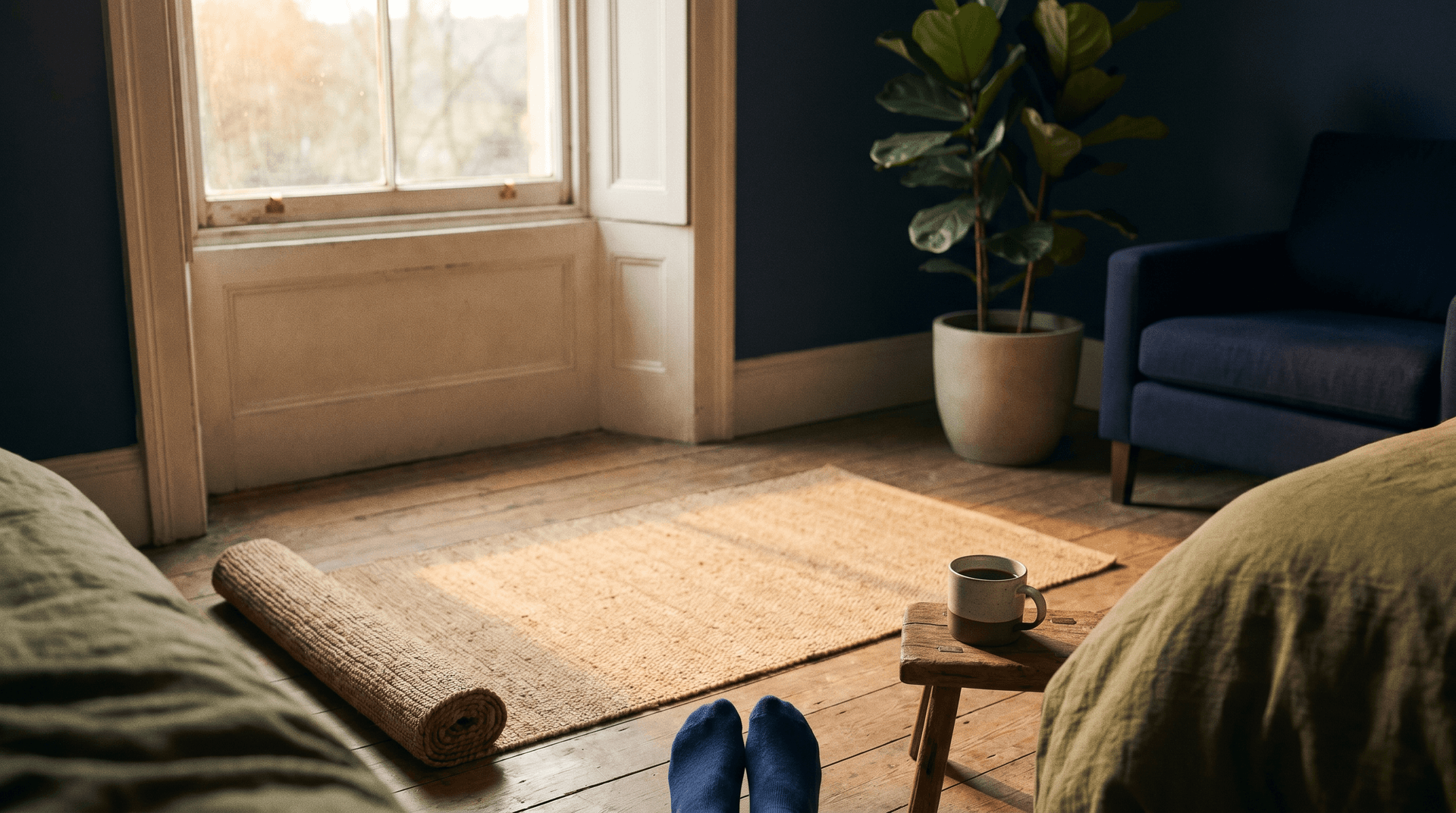
The fifteen-minute morning
Shared as my own entry-point template rather than as a prescription. Fifteen minutes, five categories of tool, one short practice that holds whether or not the rest of the day goes to plan. The coaching is how we help you build your own version of it.
Where to startThe Fifteen-Minute Morning
Roy Castleman's entry-point wellness template for UK owner-managers of service businesses. Fifteen minutes, five categories of tool drawn from Roy's own stack (breathwork, cold exposure, meditation, movement, fuel), arranged in a sequence that holds whether or not the rest of the day goes to plan. Shared as Roy's own practice rather than a universal prescription. The coaching helps each owner build their own version, because what works for one owner does not work for the next. The template is the starting point, not the destination.
My stack, shared honestly
This page is a description of my own morning practice, not a prescription for yours. I think that distinction matters more than most wellness content admits. I have spent the last three years building the stack I use myself, after a hospitalisation in 2021 made it clear that running ninety-hour weeks on nothing was no longer an option. What I built works for me. Some of it will work for you. Some of it will not. The coaching is how we help you work out which is which, and help you build your own version on the pieces that fit.
The template runs fifteen minutes because that is the shortest window where the practice actually changes the nervous system. Five minutes is not long enough. Twenty minutes tends to lose to sleep. Fifteen is the sweet spot where the operator arrives at the day regulated rather than reactive. Over ninety days most owners settle into a rhythm that floors at ten minutes on hard mornings and rises to twenty on soft ones. The floor is what matters.
Below is the shape of the template, the principles underneath it, and the specific ways I use it myself. Take what works. Leave what does not. That is the instruction.
The five categories of tool
The template draws from five categories rather than a specific sequence, because the right tool for any given morning depends on the state the operator arrived in. A menu, not a checklist.
- Breathwork. The fastest tool for shifting state. Changes autonomic-nervous-system activity inside a few minutes. My practice here is drawn from Wim Hof protocols. A box-breathing practice or a simple four-seven-eight pattern works equally well for the same purpose.
- Cold exposure. Sharpens attention and resets the stress response. My version is a cold shower at the end of a normal shower or, on better days, a short immersion. Winter sea swimming, cold plunge pools, or a cold face-dip all belong to the same category.
- Meditation. Regulates attention and creates a short space between stimulus and response. My practice is short and informal, closer to a sitting check-in than a thirty-minute formal session. Other owners I coach use guided app sessions, walking meditation, or body-scan practices. The category matters. The specific practice is yours.
- Movement. Gets the body out of the sedentary pattern a laptop-first day will otherwise hand it. My version is a short sequence of mobility drills, sometimes followed by a walk. A full yoga practice, strength sets, a run, or gardening all fit the category.
- Fuel. The first input of the day shapes the rest of it. My version is water first, then something with protein. Coffee comes after the fifteen minutes, not before. Others run a different pattern: some do not eat in the morning at all. The category is about being deliberate rather than reactive. What you choose matters less than choosing.
The Five Tools page goes deeper into each category, with specific practices I use and alternatives owners commonly adopt.
Four principles that make it hold
The template itself matters less than the four principles underneath it. Most owners who try a morning practice and watch it fail inside a month have broken one of these. Honouring them is the difference between a practice that lasts three weeks and one that lasts three years.
- Short beats long. A fifteen-minute practice held every day for a year produces more change than a forty-five-minute practice held twice a week for three weeks. Consistency compounds. Intensity does not.
- Choose the tool for the state. If you arrived anxious, pick the breathwork. If you arrived flat, pick the cold. If you arrived scattered, pick the meditation. The menu gives you the choice. A fixed sequence forces the wrong tool into the wrong morning.
- Protect the floor, not the ceiling. On the worst days of your year, what is the shortest version of the practice you can still run? That is the floor. Ten minutes is usually right. Do the floor on the hard days. Everything else is a bonus.
- Your version, not mine. Copy the shape. Choose your own specifics. A practice you own will hold. A practice you borrowed will drift.
The coaching treats these principles as the non-negotiables. Everything else is the owner's to decide.
Why the fifteen-minute morning only lands after AI
Telling a ninety-hour-a-week owner-manager to carve out fifteen minutes before email is not a useful instruction. The time does not exist. It has to be made first. This is why the Sequence Rule places AI before wellness. AI as a thinking partner (via the Brain Dump Protocol and the Business Brain) gives most owners back five to fifteen hours a week inside the first month. Fifteen minutes at dawn becomes defensible when the ninety-hour week becomes a seventy-five-hour week.
Owners who try to install the wellness practice before reclaiming any time usually fail at it. Not because the practice is wrong. Because the prerequisite was skipped.
The short version
Fifteen minutes. Five categories (breathwork, cold, meditation, movement, fuel). Choose the tool for the state you arrived in, rather than running a fixed sequence. Protect the floor, not the ceiling. Build your own version on the shape. Do it after AI has given you the time back, not before.
The template is my stack. The coaching is how we help you build yours.
Keep reading
The Wellness Pillar
The pillar hub. Where the fifteen-minute morning sits inside the full wellness stack.
Wellness Pillar · LiveRoy's Five Tools
The menu the morning template is built from. Breathwork, cold exposure, meditation, movement, fuel.
Methodology · LiveWhere to start
The Sequence Rule. Why wellness sits second, after AI has reclaimed the time it needs.
AI Pillar · LiveThe AI Pillar
The pillar that makes the fifteen-minute morning actually possible for a ninety-hour-week owner.
AI Pillar · LiveThe Double Burnout
The pattern the wellness pillar is trying to reverse. Why a depleted operator has to recover before anything else installs.
About · LiveAbout Roy Castleman
The origin story. How this stack was built after a burst colon in 2021 and why the coaching looks the way it does.